
Searching Hale County Civil Dockets
Every Hale County civil docket search starts in one place: the official Hale County Civil and Criminal Public Access portal. Have the exact cause number ready if you can. If you do not, type the party name the way the clerk indexed it, then filter by court, filing date, or status if the live form allows it. Fair warning: the portal sometimes refuses online access outright. So treat it as one option, not the only one.
Two clerks split the civil records. The District Clerk holds the dockets for the 64th and 242nd District Courts. The County Clerk keeps County Court and probate files. Small claims, debt, repair-and-remedy, and eviction dockets sit with the Justice of the Peace courts. Those are JP1 and JP3.
- Identify the likely court from the claim type and prior papers.
- Search the county portal by exact cause number or party name.
- Match the case style, court, filing date, and party roles.
- Read filings and settings in date order, including resets.
- Ask the custodian for the filed or certified document needed.
Hale County District Civil Records
Civil filings in Hale County go through the District Clerk at the Day, Boyd, LaFont Justice Center. Two courts hear them. The 64th and 242nd District Courts are general-jurisdiction courts serving Hale, Castro, and Swisher Counties, and the 242nd expressly handles civil matters, title-to-land disputes, election contests, and family cases. Which court holds your case appears in the case header, so check there first. For an online docket search, the county points to its official Civil and Criminal Public Access portal as the first stop for a Hale County civil docket.
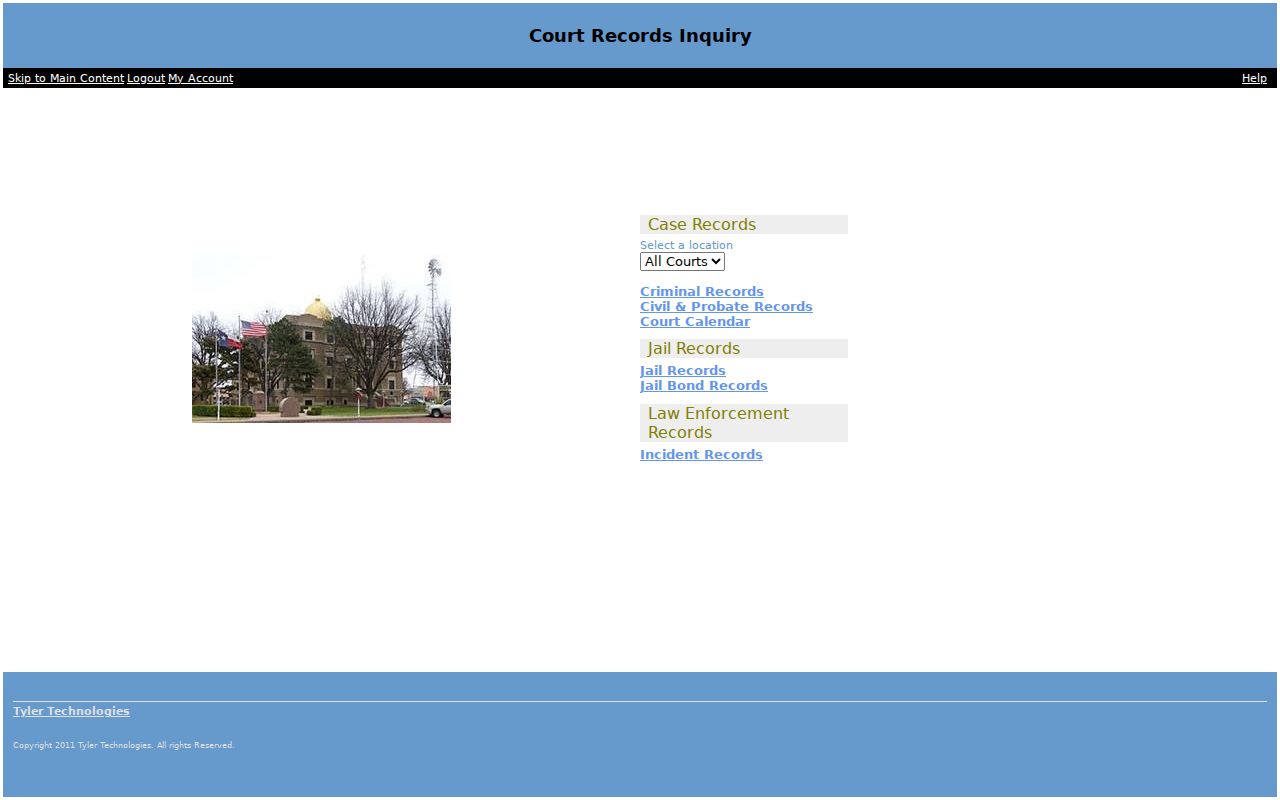
The county's own entry page is the place to begin a Hale County docket search. One caution applies. A portal result is not the petition, the proof of service, the judgment, or a certified civil docket, and if access is blocked, the next step is a request to the District Clerk.
Inside a Hale County Civil Docket
Think of a civil docket as the clerk's dated index of activity in a case. It may name the parties and attorneys. It can list the case type and track service returns, motions, notices, settings, orders, and disposition. One limit matters. A docket entry points to a filed document but is not the document itself. Read the party roles with care. Plaintiff, defendant, counterclaimant, and intervenor each describe a different position in the case.
| Cause number | The local identifier used by the clerk and assigned court. |
|---|---|
| Case style | The caption listing parties as indexed. |
| Service | Citation issued, service returned, waiver, substitute service, or failed attempt. |
| Events | Petitions, answers, motions, responses, notices, orders, and judgments. |
| Settings | Hearing or trial date, with resets and passes read in sequence. |
| Disposition | Judgment, nonsuit, dismissal, transfer, consolidation, or another result. |
Hale County Petition-to-Judgment Trail
A civil case usually starts with a petition and a filing record. Citation is issued next. The docket can show successful service, a waiver, substitute service, or an attempt that failed. An answer, counterclaim, or cross-action may follow. Discovery notices and motions fill the middle of the court record. Not every exchanged discovery item becomes a public filing, though. The later trail can include a motion to compel, a continuance, a summary-judgment request, a protective order, or a notice of setting. Endings vary: bench trial, jury trial, agreed judgment, default judgment, summary judgment, nonsuit, or dismissal. After judgment, expect entries such as an abstract, a writ, garnishment, a motion for new trial, a notice of appeal, or a mandate. A short docket label and a signed order may seem to conflict. The signed order controls.
Civil Case Types on the Docket
Which court hears a civil case turns on jurisdiction. It does not turn on where a party happens to live. A suit goes to the court whose reach the law assigns. Hale County's own pages post no current dollar-threshold chart. So check current Texas law and clerk guidance before you file. Also note that municipal courts are not general civil courts. An ordinary contract or property suit does not belong there.
| Case type | Likely Hale court | Custodian |
|---|---|---|
| General civil, title to land, election contest, family | 64th or 242nd District Court | District Clerk |
| County civil or probate | Hale County Court | County Clerk |
| Small claim or debt claim | JP1 or JP3 under current jurisdiction | Issuing justice court |
| Eviction or repair-and-remedy | JP1 or JP3 | Justice court clerk |
Before you treat any docket search result as the correct case, ask the clerk to confirm venue and jurisdiction.
Hale County Civil Disposition Terms
A short label on the docket only hints at what happened. The signed order gives the full context. Hale County publishes no complete local code dictionary, so these common Texas civil practice terms are a good frame for a clerk question.
- Agreed judgment
- The parties resolve the matter by consent and the court signs a judgment.
- Default judgment
- A judgment associated with a failure to answer or appear, subject to the record and rules.
- Nonsuit
- A plaintiff voluntarily ends a claim as reflected in the court order.
- DWOP
- Dismissal for want of prosecution.
- Summary judgment
- A ruling without a trial on a qualifying motion and record.
- Abstract
- A judgment summary used in post-judgment collection processes.
A motion asks the court for relief. It is not an order granting it. When you read the docket, check the event sequence and the document title to see which one you have.
Hale County Civil Docket Settings and Hearings
Need a hearing on the Hale County civil docket? The 64th and 242nd District Courts post calendars and request forms. The form asks for the date, the time, and how long the hearing should run. It also wants the requester's name, the attorney's name, an email for confirmation, the cause number, the case style, and the hearing type. Sending the form does not mean the court said yes. The setting is official only once the coordinator confirms it on the calendar, so check with that office before you rely on a date.
Jury weeks are easier to track. The 242nd publishes jury-week tables covering Hale, Castro, and Swisher Counties, and its Docket Information page lists each entry by county and week, item number, cause number, style, and attorneys of record.
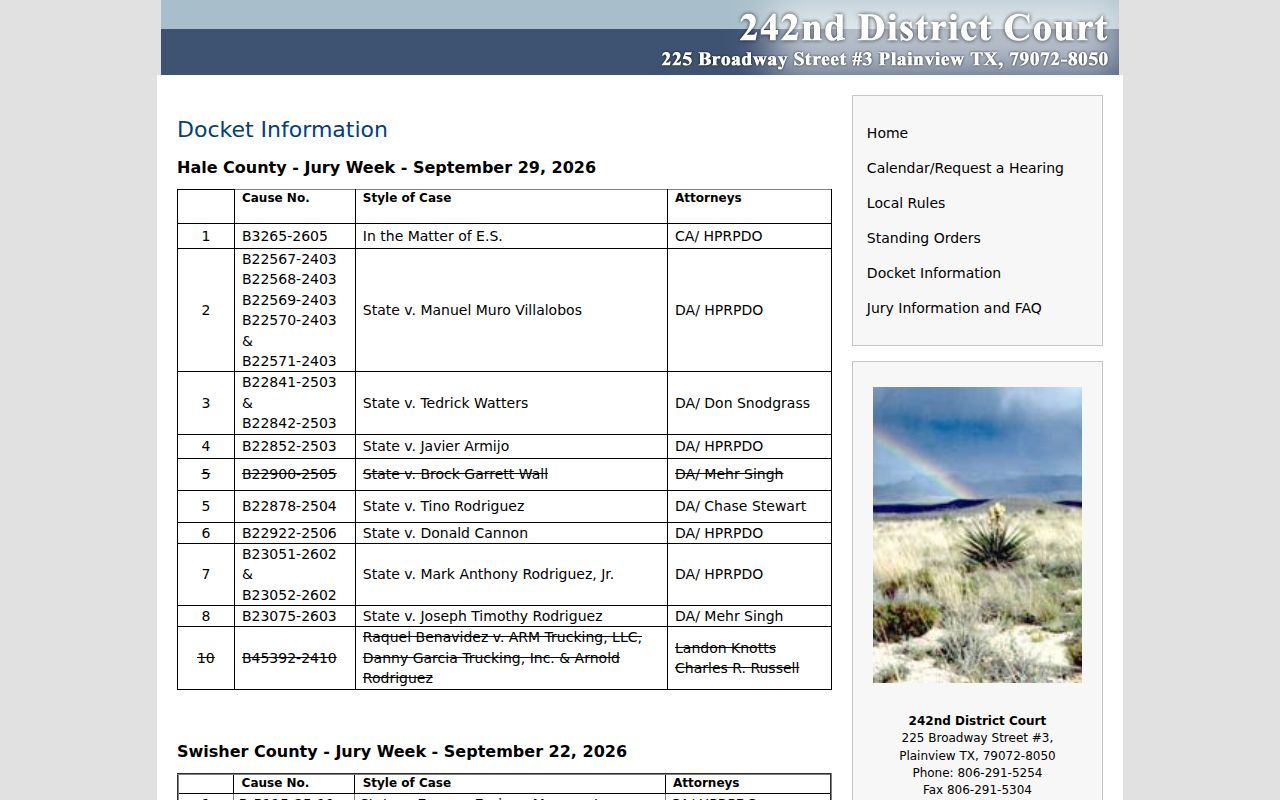
Crossed-out rows: treat them as a nudge to confirm with the clerk, not as proof the case is over.
Small Claims in Hale County
Small claims in Hale County live at the justice courts. JP1 and JP3 both handle small claims, debt claims, repair-and-remedy cases, and evictions within their civil jurisdiction. Their records may not appear in the county district or County Court portal. The justice courts sit outside that system. JP1 sits at 500 Broadway in Plainview and lists 806-291-5201. JP3 is just outside Abernathy near I-27 and FM 54, reachable at 806-757-2476. Your court papers name the precinct, so start there or simply call. Ask if staff can search a docket by party name or cause number. Ask whether a public terminal exists and how to order a plain or certified copy. The Hale pages list no current filing thresholds, copy fees, portal fields, or turnaround times. Each precinct runs its own process. Never assume what works at one will work at the other.
Hale County Civil Clerk Channels
The District Clerk's office sits at 225 Broadway, Suite 4, Plainview, Texas 79072-8050. It answers at 806-291-5226. Published hours run 8:00 a.m. to noon and 1:00 to 5:00 p.m., Monday through Friday. The County Clerk is at 500 Broadway, Room 140, phone 806-291-5261. Its published weekday hours are 8:00 a.m. to 5:00 p.m., with a noon closure.
Search online first. Then call or visit the counter that actually holds the record. A written or mailed request should list the court, cause number, parties, filing year, document title and date, copy type, return address, and a contact number. Ask the office which mail, fax, or email method it accepts for that record. re:SearchTX offers a statewide second path, though registration and document charges may apply. For a certified copy, only the clerk of court can issue it. So go straight to that office rather than a printout of your own.
Civil Docket Access Rules
Texas treats court case records differently from ordinary agency records under the Texas Public Information Act. Access flows from court rules, statutes, and orders instead. The Texas judiciary open-records policy separates case records from judicial administrative records, which fall under Rule 12. Expect added restrictions on family and juvenile material.
Access check: A visible order does not make a sensitive exhibit public. Sealing, redaction, juvenile confidentiality, protected personal data, or an older offline file can explain why an item is missing.
An empty docket result is not the end. Try the exact cause number and different spellings of party names. Then contact the clerk directly. When an office denies access, ask which legal rule or court order controls that decision. For an older file, give an approximate filing date and a precise description of the document. The clerk can quote retrieval, copy, certification, and delivery terms. But those fees never change the court's access ruling.
Keep the clerk’s response with the request so later follow-up uses the same court, document title, scope, and copy format.